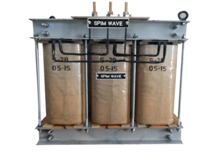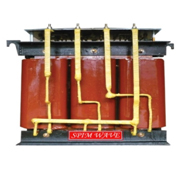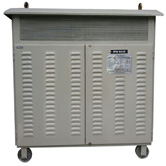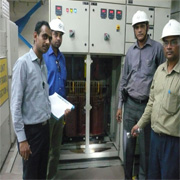

LIGHTING TRANSFORMER
Lighting Transformers: are isolation transformers specific to applications of lighting and their specifications. They have specific and stringent requirements of impedance and protection. Infact a special category of K-rated transformers is gaining in popularity with many IT based companies and applications.
In an electric power system, a load with a low power factor draws more current than a load with a high power factor for the same amount of useful power transferred. The higher currents increase the energy lost in the distribution system, and require larger wires and other equipment. Because of the costs of larger equipment and wasted energy, electrical utilities will usually charge a higher cost to industrial or commercial customers where there is a low power factor.
A high power factor is generally desirable in a transmission system to reduce transmission losses and improve voltage regulation at the load. It is often desirable to adjust the power factor of a system to near 1.0. When reactive elements supply or absorb reactive power near the load, the apparent power is reduced. Power factor correction may be applied by an electrical power transmission utility to improve the stability and efficiency of the transmission network. Individual electrical customers who are charged by their utility for low power factor may install correction equipment to reduce those costs.
Harmonic currents generated by non-linear loads can cause problem is in the power systems and particularly the distribution transformers as they are vulnerable to overheating and premature failure. Normally designers recommend an oversized transformer to protect transformer from overheating. K-factor transformers are specifically designed to accommodate harmonic currents. K transformers are preferred because they have additional thermal capacity of known limits, design features that minimize harmonic current losses, and neutral and terminal connections sized at 200% of normal . K-rated transformers allow operation up to nameplate capacity without derating.
GENERAL ASPECTS:
- High efficiency, high reliability and accuracy, Compact, rugged in construction, free standing, floor mounting model and housed in sturdy sheet metal casing with sufficient ventilations.
- Double wound with copper conductor with low coupling capacitance to Isolate the voltage spikes and noise from the mains.
- High Insulation values.
- Suitable for use with modern sophisticated micro processor based equipments, CNC machines, computers and other Industrial processing.
- Supply and outgoing terminals brought out with proper brass bolts and double nuts and washers under sheet secured cover with proper making.
- The main body of the equipment shall have double earthing arrangement.
- To withstand the ambient temperature up to 55o C and 95% humidity.
- Suitable for balanced and un-balanced loads
- Transformers shall be provided with rating plate giving the details.
- No spare required for 2 years of normal operation.
TECHNICAL ASPECTS :-
- Isolation resistance shall be greater than 1000 M. ohms at 500 V DC
- The transformer regulation shall be less than 7.5%
- Noise/Spike suppression shall be more than 135 db.
- The magnetizing current shall be less than 10% of the full current load.
- The transformer shall in general meet IS:2026.
- The transformer is provided with one electrostatic shield between the primary and the secondary.