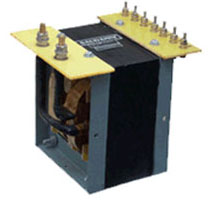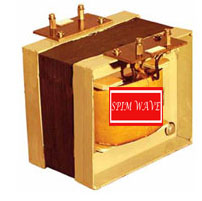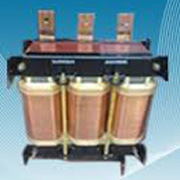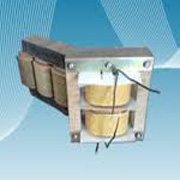

Step Down / Step Up Transformer
A transformer converts alternating current (AC) from one voltage to another voltage. It has no moving parts and works on a magnetic induction principle; it can be designed to "step-up" or "step-down" voltage. So a step up transformer increases the voltage and a step down transformer decreases the voltage.
A step-up transformer is one whose secondary voltage is greater than its primary voltage. This kind of transformer "steps up" the voltage applied to it. For instance, a step up transformer is needed to operate equipments required high voltage than the rated supply.
A step-down transformer, as evidenced by the high turn count of the primary winding and the low turn count of the secondary. As a step-down unit, this transformer converts high-voltage, low-current power into low-voltage, high-current power. The larger-gauge wire used in the secondary winding due to the increase in current. The primary winding, which doesn't have to conduct as much current, made of smaller-gauge wire.